Well, this is a hoot! Neil Bauman of Geek Cruises is putting together several non-geek cruises -- one on opera, one on chess, and a ten-day cruise to the Panama Canal called Shakespeare at Sea! It leaves from Ft. Lauderdale and wanders around the Caribbean, goes into the Panama Canal and turns around in that big lake, then heads on back. The cruise is co-sponsored with the Oregon Shakespeare Festival in Ashland. There's quite a nice line-up of presentations, films, discussions, performances. I'll be giving four or five talks, plus I'll be the emcee for a really great quiz show. And I'm working on creating pages of "Shakespeare" games that will be slipped under your door every morning, games that test your knowledge of the works. Oh, it's much more fun to do this than to work for a living.
I will bring along a presentation about Mary Sidney and her role in the authorship question, just in case anyone is interested in hearing more about the possibility. But nothing will be pre-publicized about that talk because there are those who are afraid it might make some people refuse to show up! ;-) Which is true. sigh.
The cruise-plus-conference is rather expensive (depending on the room you choose), but Neil has kindly offered a "Friends of Robin" discount of $300 per person if you sign up before Thanksgiving. It would be great if I wasn't the only MarySidneian on board!
Friday, November 10, 2006
Thursday, November 02, 2006
The Cygnet, a journal of inquiry

The Mary Sidney Society has published its first journal, called The Cygnet. The journal is dedicated to publishing articles relating to all aspects of Mary Sidney, her relationship to the authorship question, pertinent information about the Shakespearean works, as well as articles about other unsung women. The journal is sent to members of the Mary Sidney Society, but when our redesigned web site is up, we'll have a shopping cart where the limited number of extra copies will be available. It's not only an interesting journal, it's beautiful!
Wednesday, November 01, 2006
Sidney Supper 2006
The Fourth Annual Sidney Supper celebrating Mary Sidney's birthday was a Grand Success! We had a pageant full of earnest volunteers, a feast, Falstaff's Photo Op, an Elizabethan dance lesson! People came from California, Texas, Kentucky, and Ohio. Dana Evans showed her eleven-minute trailer with which she's applying for funds for a documentary.
The Cygnet Award to honor unsung women was presented to Beatrice Ntuba of Cameroon, accepted by Barbara Riley. The Bard-Buster Award for the person who has spent inordinate time and energy toward the authorship question and Mary Sidney was awarded by Jim’Bo Norrena to Dana Evans -- she was presented with a plaster bust of William Shakespeare, which she can decorate as she likes over the next year; at the Sidney supper 2007, she will present the award to the next worthy winner.
There are a few photos posted on our iWeb site. We hope you can either join us next year or start your own tradition of Sidney Suppers in your hometown! This event was sponsored by the Mary Sidney Society.
The Cygnet Award to honor unsung women was presented to Beatrice Ntuba of Cameroon, accepted by Barbara Riley. The Bard-Buster Award for the person who has spent inordinate time and energy toward the authorship question and Mary Sidney was awarded by Jim’Bo Norrena to Dana Evans -- she was presented with a plaster bust of William Shakespeare, which she can decorate as she likes over the next year; at the Sidney supper 2007, she will present the award to the next worthy winner.
There are a few photos posted on our iWeb site. We hope you can either join us next year or start your own tradition of Sidney Suppers in your hometown! This event was sponsored by the Mary Sidney Society.
Tuesday, October 03, 2006
Breakfast with Mark Rylance
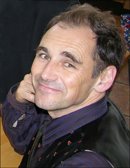
Mark Rylance was the original Artistic Director of Shakespeare's Globe Theatre in London from the time it opened in 1996 until this 2006 season. He's also the Director of the Shakespearean Authorship Trust in London, which was started in 1922 to support research into the authorship. He's also one of the greatest Shakespearean actors today. Mark's adorable wife, Claire van Kampen, also recently stepped down as the Musical Director at the Globe. They were both staying with friends in Santa Fe for a week and we had breakfast together.
Since Mark and Claire left the Globe, they've been pretty closed about what future options they're exploring. I do know that Mark is writing several plays, including one about the authorship. In it, Mark gets visited by William Shakespeare; Sir Francis Bacon; Edward de Vere, the Earl of Oxford; and Mary Sidney. Each one talks about their authorship of the plays and sonnets, and Mark goes into the audience with a microphone so they can ask questions of the candidates. He's asked me to go to London for a month to help train the actress to "be" Mary Sidney. Gosh darn, I'll have to live in London for a month. ;-) The play will open in Chichester sometime in early 2007.
Wednesday, July 26, 2006
My SwanMobile!
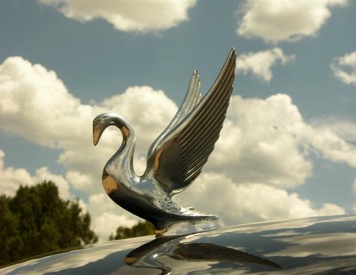
Okay, I will bet that I have the only Toyota Matrix in the world with a chrome-plated swan hood ornament. I bought it on eBay for $9. Tommy Segura, my dear friend and one of the greatest guys in the world, shined it up and put it on for me.
Now my car—with its license plate holder that says “Mary Sidney” and its bumper sticker that says “Who is Mary Sidney” and now its swan hood ornament—is a traveling commercial. The things one must do to sell books.


Tuesday, July 18, 2006
The cave at Milford Haven
People always ask me how things might change if it turns out to be proven that Mary Sidney wrote the works attributed to Shakespeare. I do believe we certainly won’t lose anything—and we will gain so much. It’s very satisfying to connect an author with the works.
Here’s a very simple example. Dorothy Parker wrote an epigram that goes like this: Guns aren't lawful; nooses give; gas smells awful; you might as well live. Now, that’s a odd little piece, but it becomes much more interesting when you learn that Dorothy Parker tried to commit suicide at least four times.
It’s always been sad that don’t have that opportunity with Shakespeare; we haven’t been able to connect anything in William Shakespeare’s life with this rich, emotional, powerful body of work. Here’s a minor example of how interesting it could be when linking Mary Sidney Herbert, the Countess of Pembroke, to the plays:
In the Shakespearean play Cymbeline, the heroine, Imogen, runs away to Wales, specifically to the town of Milford Haven in Pembrokeshire. Milford Haven is mentioned by name fifteen times. There is a cave in Milford Haven where two young men were raised (Imogen’s brothers, who were stolen at birth); the cave is mentioned almost a dozen times. This all becomes much more interesting when you realize that in the town of Milford Haven there really is a cave. Access to the cave is through Pembroke Castle, Mary Sidney's estate. From inside the castle, you climb down fifty steps into a cave that opens out to a view of the river.
What a delightful treat to go exploring the castle and cave knowing that she was there and that this spot inspired the play Cymbeline!
Here’s a very simple example. Dorothy Parker wrote an epigram that goes like this: Guns aren't lawful; nooses give; gas smells awful; you might as well live. Now, that’s a odd little piece, but it becomes much more interesting when you learn that Dorothy Parker tried to commit suicide at least four times.
It’s always been sad that don’t have that opportunity with Shakespeare; we haven’t been able to connect anything in William Shakespeare’s life with this rich, emotional, powerful body of work. Here’s a minor example of how interesting it could be when linking Mary Sidney Herbert, the Countess of Pembroke, to the plays:
In the Shakespearean play Cymbeline, the heroine, Imogen, runs away to Wales, specifically to the town of Milford Haven in Pembrokeshire. Milford Haven is mentioned by name fifteen times. There is a cave in Milford Haven where two young men were raised (Imogen’s brothers, who were stolen at birth); the cave is mentioned almost a dozen times. This all becomes much more interesting when you realize that in the town of Milford Haven there really is a cave. Access to the cave is through Pembroke Castle, Mary Sidney's estate. From inside the castle, you climb down fifty steps into a cave that opens out to a view of the river.
What a delightful treat to go exploring the castle and cave knowing that she was there and that this spot inspired the play Cymbeline!
Monday, July 10, 2006
A good listener?
I recently returned from Chicago, New York City, and Portland, Oregon after a spate of discussions, book signings, and radio interviews. The radio show in Chicago with Milt Rosenberg included Peter Holland, a British professor of Shakespeare teaching here in America at Notre Dame. When a caller asked how William Shakespeare acquired the amazing range of knowledge shown in the plays, Holland said “I believe Shakespeare was a good listener.”
I think that’s so sad. It’s sad that Shakespeareans must denigrate the breadth and depth of the knowledge of this writer merely so they don’t have to explain where he came by such a wealth of book learning including study of rhetorical devices, languages, history, mythology, medicine, the classics, etc. “A good listener.” Sheesh. That’s like saying Albert Einstein or Marie Curie did what they did by being good listeners.
How much more satisfying and inspiring it will be when we can take a close look at the education of this writer. It might help us gain a sense of how she came to do what she did; we might better comprehend how these plays developed and gain a clearer understanding of how the knowledge in them was transmuted into such art. Then we can begin to more fully understand and appreciate the brilliance of the mind that wrote them. That would be much more satisfying than pathetically believing the writer was merely “a good listener.”
I think that’s so sad. It’s sad that Shakespeareans must denigrate the breadth and depth of the knowledge of this writer merely so they don’t have to explain where he came by such a wealth of book learning including study of rhetorical devices, languages, history, mythology, medicine, the classics, etc. “A good listener.” Sheesh. That’s like saying Albert Einstein or Marie Curie did what they did by being good listeners.
How much more satisfying and inspiring it will be when we can take a close look at the education of this writer. It might help us gain a sense of how she came to do what she did; we might better comprehend how these plays developed and gain a clearer understanding of how the knowledge in them was transmuted into such art. Then we can begin to more fully understand and appreciate the brilliance of the mind that wrote them. That would be much more satisfying than pathetically believing the writer was merely “a good listener.”
Subscribe to:
Posts (Atom)